In his article, Paul Sakkal says the prime minister’s calling of a royal commission was a “backdown”, and his changes to the government’s antisemitism omnibus bill an “embarrassing capitulation” (“Albanese’s capitulation is embarrassing, but at least it avoids moment of national shame”, January 18). Sounds like having a bob each way. As the country’s leader, the prime minister has had to deal with an unimaginably difficult situation. Attacks from everywhere, most of it unfounded; demands for various outcomes, many incompatible; and having to negotiate a way forward in a minefield of agendas and sensitivities. The outcomes delivered so far are a royal commission with sensible terms of reference and a quick timeframe and, if passed, legislation reflecting increasingly rare phenomena in our parliament – genuine negotiation and compromise. Nothing embarrassing about that at all. Quite the contrary. Michael Hinchey, New Lambton
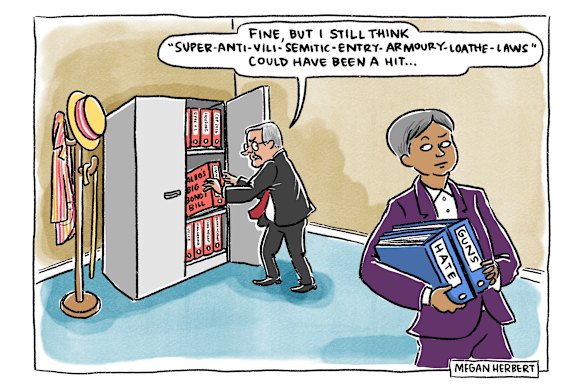
Credit: Megan Herbert
The PM’s retreat on his omnibus bill is to be applauded. At a time when national unity is of paramount importance, he sensibly saw his actions tearing at our social fabric and shifted position. His challenge now is to stop criticising the actions or inaction of his political foes and demonstrate the humility needed to build consensus. His success will reflect greatly on our society’s ability to unite for a common purpose in response. Rebukes and blame-filled rhetoric can never lead to unity. Brian Barrett, Padstow
As an everyday Australian with no particular political affiliations, I have watched while PM Albanese has been steadfast (“Labor backs down on post-Bondi changes as political support collapses”, January 18). He steadfastly wouldn’t disclose the terms of the Voice, he steadfastly backed Kevin Rudd, he steadfastly wouldn’t call a royal commission and now he steadfastly does another u-turn on another decision. But at least he has been steadfast. David Sayers, Gwandalan
Saturday’s letters provide an interesting range of viewpoints regarding proposed new laws, including whether they may be unwisely rushed (Letters, January 17). Those worried about this should remember the legal maxim that “anything that is done (by the parliaments) can be undone” – for example, where legislation is found by experience to be the wrong way to attack a problem. Remember also that the there is a constant stream of amendments to acts and regulations flowing through the system: corrections to hate speech or gun control will be nothing new. Bruce Graham, Waitara
On a lighter note, has anyone else noticed that the prime minister’s ties are much more interesting since he has been married? Judith Walder, Randwick
Trump insults allies
In a recent article, David French wrote of Donald Trump’s threats to Denmark. He drew a contrast with a young Danish man who suffered a serious war injury while supporting the US in Afghanistan, and Trump subsequently seeking to acquire (or “invade”) the friendly Danish-controlled territory of Greenland. The fact is that Trump places no value on the contribution allies make to defending the so-called free world (“Something is rotten in the States”, January 17). In the past, he has even indicated his belief that those who make a sacrifice on behalf of their country are “losers”, and by avoiding the draft, he made sure he was not one of them. His vile criticism of wounded war hero John McCain is a striking example of his attitude. Anyone with expectations of him showing any sign of normality or sense of obligation towards those who exhibit real patriotism are likely to be sadly disappointed. Derrick Mason, Boorowa
Yes, David French, we have to guard our alliances with like-minded democracies and protect our own world-class democracy from crazed Trumpism. The government is to be congratulated for having so skilfully negotiated our relationships with China, the South Pacific and even with rogue US. Andrew Macintosh, Cromer
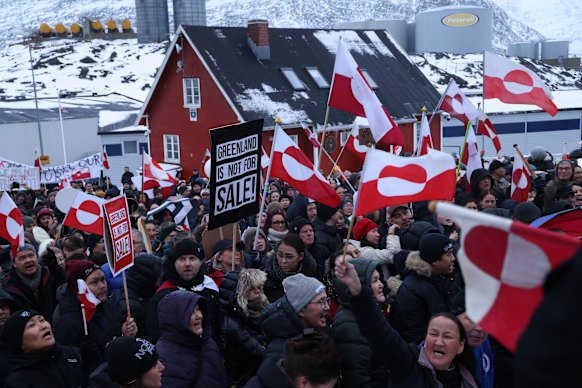
Greenlanders protest in front of the US consulate in the capital, Nuuk.Credit: Getty Images
Canada’s PM, Mark Carey, has bitten the bullet and signalled a break from alignment with Trump’s trade agenda (“Canada pivots from Trump to rebuild ties with China”, January 18). His fallback position is to negotiate a trade deal with China. Carney’s deal exemplifies the position many countries find themselves in. Between a rock and a hard place, caught between the devil and the deep blue sea. A dilemma where whichever rein you pull has the potential to make matters worse. Lyn Savage, Coogee
Trump has slapped tariffs on eight European countries for daring to oppose a US takeover of Greenland, declaring the tariffs will stay in force until a “deal” is struck for the island (“The reasons Trump’s tariff threats won’t hand Greenland to him”, January 18). Perhaps it’s time for the Western world (including us) to file for divorce from America and enter a temporary marriage of convenience with China. Remarrying America can wait until Trump is gone. Mokhles Sidden, Strathfield
History repeats
As distasteful as the Iranian regime is, what we are witnessing is a textbook US coup with assistance from Israel (“Iran’s leader calls Trump ‘criminal’, blames US and Israel for ‘thousands’ of deaths”, January 17). First, you destroy the economy with sanctions to foment unrest, as they did in Venezuela. Then you arm and finance the opposition – in this case we have Israeli operatives on the ground in Iran helping them, a fact confirmed by Israel. Finally, if you succeed, you install a puppet leader with echoes of 1953. Anyone who thinks this is a humanitarian action has rocks in their heads. Graeme Finn, Campsie
The US has for decades played a significant role in regime change in Iran – the overthrow of democratically elected Mohammad Mosaddegh in 1953 after he nationalised the oil industry, the reinstallation and support of the monarchy, which ultimately led to its overthrow and the establishment of today’s Islamic Republic. Now that is about to be toppled. The return of the Shah’s son to lead the country hardly seems a democratic move (“As Iranians risk their lives to protest, an exiled prince emerges as a leader”, January 17). Alberto Bizcarra, Rozelle
Is this really what we’ve now got? The “leader of the free world” is a whimsical, capricious bowling ball trundling around on the world stage. He encourages Iranian opposition with cries of “help is on the way”, ensuring more Iranian lives are lost. And what happens? Precious little and certainly no support or considered action or response. There is now Iranian blood on Trump’s hands. Will he even notice? Will he even care? Heaven help us all. Jeff Stewart, Huskisson
Awkward AUKUS
Alan Moir’s AUKUS cartoon reminded me that the awkward acronym is deceptive (Letters, January 17). Rearranged as USUKA, the true power hierarchy is revealed. We are, of course, at the back end. The massively expensive scam is not to defend us but to sucker Australian taxpayers into subsidising the US demand for hegemony in the western Pacific and to “contain” China. None of our Asian neighbours display the same baseless fear. Malaysian Prime Minister Anwar Ibrahim said his country enjoyed a “comfortable accommodation” with China. As Malcolm Fraser pointed out in his book of that title, the Americans are Dangerous Allies. When Scott Morrison announced the arrangement close to the 2022 election, Anthony “Me-too” Albanese stuck his hand up in ready compliance. He could and should have said that if elected, he would consider whether it was in Australia’s best interests, as opposed to the US’s. Successive Australian PMs have compromised our sovereignty for no benefit. Adrian Gattenhof, Valentine
The issue with the AUKUS agreement is that both the US and Britain are being paid for providing nothing and that any current and future Australian governments will be too afraid to admit they have been swindled. Defence experts all seem to agree that Australia will never see a submarine and the result will descend into a compromise of some other defence agreement. If only our politicians on both sides of the fence could be honest with the Australian people concerning jettisoning the AUKUS agreement, then luck could be on our side. There now appears to be valid evidence that these mammoths of the seas will be detectable by future technologies, rendering them steel coffins under the seas. If only both sides of our politics could come together to rid us of this fraught program. Maybe pigs will fly. Tony Lewis, Mount Victoria
Calamity still ignored
Bianca Hall is right – we’ve had ample warning that we’re in a climate emergency (“Fires and floods mean we can no longer pretend this isn’t a climate crisis” January 17). Once again, we see Australian communities evacuated and hundreds left homeless in the wake of the Victorian bushfires. That is not to mention the devastation to agriculture and wildlife. In the same week, we get to witness the surreal image of cars being swept into the ocean after intense flooding off the Great Ocean Road. What motivated the prime minister to recently approve extending the life of the Ulan coal mine project near Mudgee is anyone’s guess. Coal is a known climate change accelerant. Its continued production must be curtailed if we are to avoid the worst effects of global warming. The climate elephant in the room is running rampant, yet our politicians continue to look the other way. Anne O’Hara, Wanniassa (ACT)
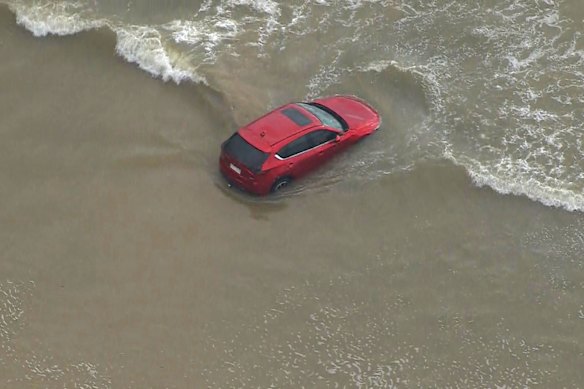
Cars were washed into the sea on the Great Ocean Road.Credit: Nine News
With the US president grabbing Venezuela for its oil and the leader of Uganda winning an election on the promise to boost the country’s fortunes by opening up the local oil industry, combined with reports of the past three years being the hottest on record (“The past three years were the world’s hottest on record”, January 15), it is clear that strategies to decrease fossil fuel consumption alone are not having their intended impact. Sure, bring on solar and wind for electricity and continue to develop efficient EVs for transport, but the environment needs more assistance. Perhaps it’s time to place a greater emphasis on removing already released carbon from Earth’s ecosystem? Reforestation and funding research into scalable carbon capture technologies would be a good start. Dale Bailey, St Leonards
Correspondent Phil Armour, who bemoans the lack of EV-charging facilities in residential developments (Letters, January 17), may not realise that an owner’s corporation in a block of units cannot unreasonably withhold permission for a lot owner to make changes that don’t significantly affect the structure, or appearance, of the building. I live in a small block and asked permission to install an EV charger, connected to my unit’s electricity meter and next to my parking space. “Looking to the future”, as Phil puts it, the owners saw the benefit of the installation and now we have appropriate wiring for any owner to install an EV charger as and when they want to. Charging is very slow, but using off-peak electricity, I can fill the batteries from empty in a couple of nights. Tony Phillips, Turramurra
Scrapheap of history
Matt O’Sullivan writes about the ignominious fate of one of our old ferries (“Large Manly ferry and last of RiverCats to be turned into scrap metal,” January 15). Despite a 14,000-signature petition to sink the MV Collaroy and turn it into a dive wreck, it looks as though the government has gone down the path of least resistance. The decision to scrap the Collaroy will turn another piece of NSW heritage into scrap iron, while ignoring the positive impacts a dive wreck could have on small business, tourism and the aquatic environment. The decision makers have provided no information on how they reached their conclusion. It doesn’t pass the pub test. Graham Willis, Wollstonecraft
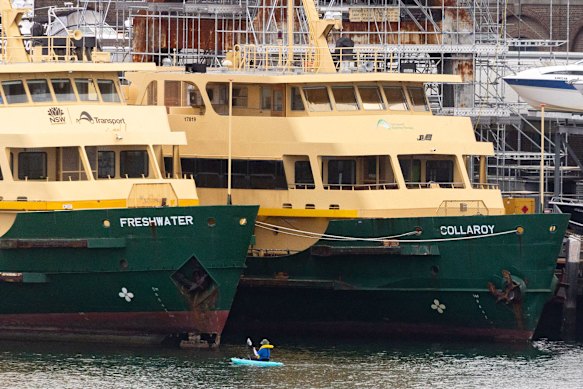
The Collaroy, right, tied up beside the Freshwater ferry at Cockatoo Island on Tuesday.Credit: Sam Mooy
Best of a Bard bunch
A good thing that Charles Dickens was not on the guest list of Adelaide Writers’ Week. The antisemitic depiction of the heinous, murderous, villainous Jewish Fagin in Oliver Twist fulfilled every negative stereotype of Jews as accepted in Victorian England (Letters, January 17). Unlike Shakespeare and Shylock, Dickens did not allow Fagin any redeeming features or encourage sympathy for his eventual demise. Those thinking about productions of Oliver might wish to rethink, like those who cancelled their production of The Merchant of Venice (“Actors halt performance of play after Bondi massacre”, January 16). Sharon Everson, Wyoming
The Bard would be in trouble today. Apart from The Merchant of Venice, which has been postponed for reasons of sensitivity, two other potentially contentious plays spring to mind: The Taming of the Shrew is very hostile to women’s freedoms and is verbally abusive to them in a way that has overtones of domestic violence. And don’t mention the “Scottish play”, otherwise known as Macbeth, which paints the Scots as a conniving, murderous lot. Greg Lewin, Tumbi Umbi
Answer in plain sight
When so many of the government’s proposals face obstacles of one sort and another (“The court battles over multimillion-dollar towers in Mosman and Neutral Bay”, January 17), it’s a mystery why they don’t go after the low-hanging fruit. Why isn’t Parramatta Road lined with six-storey blocks in place of so many two-storey, half-defunct shopping strips? Keep the facades if you like, have some shops at street level. Greater density might bring in more customers. And the same goes for so many other underused locations. Alex Jones, Kirribilli
- To submit a letter to the Sydney Morning Herald, email letters@smh.com.au. Click here for tips on how to submit letters.
- The Opinion newsletter is a weekly wrap of views that will challenge, champion and inform. Sign up here.