Life is difficult in the cold, high-altitude desert of Ladakh, India, in the western Himalayas. Vegetation is sparse, food is scarce and the air is thin.
But an array of rare and unique species – including Tibetan argali, or mountain sheep, snow leopards and black-necked cranes – have managed to carve out a life in a region often known as the roof of the world.
So has a much more familiar creature: the domestic dog.

A street dog in Ladakh, India. There are now about 25,000 feral dogs roaming free around the region.Credit: Matt Hunt / Anadolu via Getty Images
Although exact figures are hard to come by, some estimates suggest that 25,000 dogs roam freely around Ladakh. The dogs, which can carry a range of diseases, including rabies, pose a well-known threat to human health; dog bites have been on the rise in the region, and fatal attacks have occurred.
In recent years, however, conservationists have grown increasingly concerned about an additional problem. “Dogs also seem to be having an overwhelming impact on wildlife,” said Abi Vanak, an ecologist at the Ashoka Trust for Research in Ecology and the Environment in Bangalore, India. The dogs hunt and harass wild animals, and compete with them for limited resources.

A dog eating a blue sheep that was killed the night before by a pack of wild dogs in Himachal Pradesh, a few kilometres outside Ladakh. Blue sheep are also a favourite prey of snow leopards.Credit: Kyle Obermann
Feral cats can also pose a serious threat to wildlife, and some countries, such as Australia, have declared “war” on free-ranging felines. But in India – not just in Ladakh but across the country – free-ranging dogs have become a high-profile problem with few easy solutions. Culling stray dogs is generally illegal, and it’s an unpopular idea in a nation where compassion for animals is a strongly held value. And sterilisation campaigns, some experts say, have been too slow and labour-intensive to make a real dent in the enormous canine population, which has been the subject of fierce political debate.
“It’s quite an emotive issue,” Vanak said. “People love dogs. I love dogs, too.” But, he added, “I have strong opinions about some of the issues that dogs create when they’re not taken care of properly.”
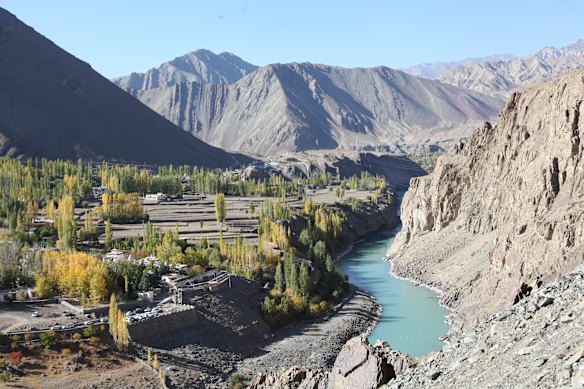
The Indus River Valley in the Cold Desert of Ladakh, India.Credit: Corbis via Getty Images
Some of the free-ranging dogs in Ladakh are pets, allowed to roam the region on their own, but many have no owners. Some are recent strays, while others come from a long line of village or feral dogs without owners.
Still, the animals rely on human handouts. In many cities, dog lovers and animal welfare groups leave food out for the dogs as an act of care and compassion. The dogs also scavenge on food waste, which has become a particular problem in Ladakh. These scraps have become more abundant in recent years as tourists have flocked to the area, fuelling a boom in new restaurants and other businesses, and the military has increased its presence in this sensitive border region.

The street dogs in Ladakh, India have many supporters who feed them and do not want them culled.Credit: Matt Hunt / Anadolu via Getty Images
“In these massive army camps, a lot of food wastage gets left out,” said Anub Paljor, a consultant to the Department of Forest, Ecology and Environment in Ladakh. “Now, because of easy availability of food, more puppies are surviving.”
But in the winter, when tourism tapers off, many dogs have to find food elsewhere. They often prey on livestock, but they also chase down wild animals like the Tibetan wild ass, or kiang. They dine on an assortment of small mammals, including woolly hares and Himalayan marmots. And they prowl around the nests of water birds, eating eggs and chicks.
For some species, like the black-necked crane, which is the state bird of Ladakh, the dogs pose “a huge challenge”, said Neeraj Mahar, a project scientist at the Wildlife Institute of India.

The black-necked crane is the state bird of Ladakh and also found in other Himalayan regions.Credit: iStock
Even when the dogs aren’t killing wildlife, they compete with wild animals for scarce resources, eating carcasses that might otherwise feed vultures, wolves, foxes, lynxes and snow leopards. “I myself have a video of around 10 dogs surrounding a snow leopard and harassing the snow leopard, not letting the snow leopard eat its kill,” Paljor said.
Still, the overall impact of dogs on the ecosystem is not well understood and is likely to be complex, said Rashmi Rana, a doctoral student at the University of Technology Sydney in Australia and a research scholar at the Nature Conservation Foundation in India. For instance, dogs might chase other wild animals like wolves away from livestock, making shepherds less likely to kill predators that could threaten their livelihoods, she said. Some research from Nepal, she added, suggests that free-ranging dogs could also be a food source for snow leopards and Himalayan wolves.
“We need more nuanced and critical studies that look at all animals, including dogs, as part of the ecological system,” Rana said. A better understanding of the dogs’ ecology might help experts devise better strategies for “cohabitation and coexistence”, she added.
Solving the problem is likely to require an array of complementary approaches, including continued sterilisation efforts, better waste management and public education, experts said. More targeted efforts might be needed around especially sensitive conservation areas; sterilisation programs could target those locations, and some dogs might ultimately need to be removed from those areas and relocated.
In the end, Vanak said, controlling the free-ranging dog population would benefit not just people and wildlife but the dogs themselves, which are prone to malnutrition, infectious diseases and accidents. “It’s not a good life for the dogs to be on the street,” he said.
This article originally appeared in The New York Times.
Get to the heart of what’s happening with climate change and the environment. Sign up for our fortnightly Environment newsletter.