Australian householders are exploring budget-friendly backyard pool options as temperatures soar and the cost of living continues to bite.
Increasingly popular are stainless-steel plunge pools, which can cost much less to buy and install than concrete or fibreglass swimming pools.
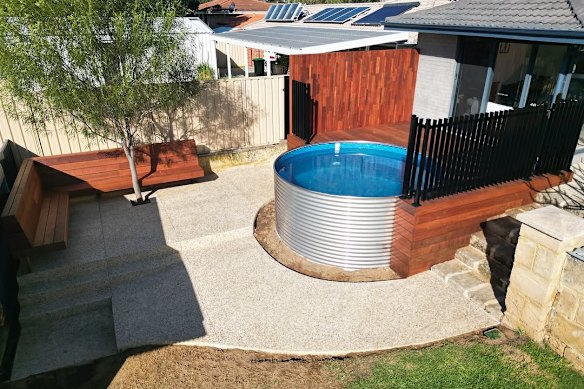
Above ground stainless-steel plunge pools can start from about $9000, plus extras and installation.Credit: Outback Plunge Pools
“You can roll a plunge pool down the side of your block, or carry it over a fence,” said Outback Plunge Pools managing director Beau Rixon.
Unlike many backyard swimming pools, plunge pools are designed to sit above ground.
“All you need is a base preparation, like a concrete slab,” said Rixon.
Outback’s entry-level plunge pool measures 2.4m across, is 1.08m deep and costs $8790 if self-installation is selected.
It features an all-in-one filtration and heating system and a range of optional extras.
The company also sells a high-spec plunge pool, which can be clad in various shades of Colorbond stainless steel, for $14,390 or up to $25,000 with optional extras.
“That higher price includes water jets, lighting, seating, a ladder – the lot,” said Rixon.
“You could buy a larger prefab concrete pool for the same money, but once you factor in transportation and craning costs, you’re spending a lot more.”
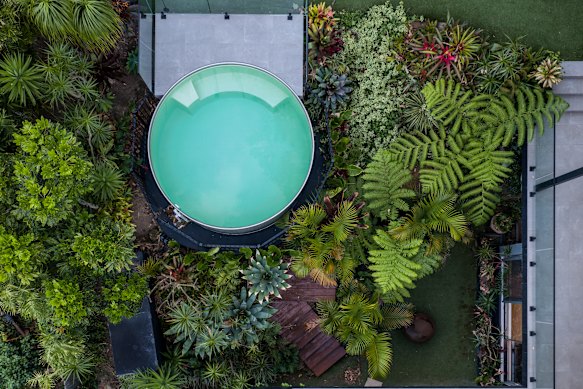
Plunge pools can be customised with seating and lights.Credit: Outback Plunge Pools
It’s not unusual for craning to cost $10,000 or $15,000, Rixon said.
AEON Pools director Adrian Swain said bill shock was a common issue for householders who embarked on backyard-pool projects.
“To control costs, you must start with a plan,” Swain said.
That includes safety considerations such as fencing, which is required by law in most states and territories, even for above-ground pools.
Whether you are opting for a compact plunge pool or a larger in-ground pool, ensure compliance with council regulations before you begin spending money.
You may opt to engage a private certifier, such as a pool installer, to handle council approvals on your behalf.
Another important – but often overlooked – budgetary consideration is landscaping, said Swain.
“If you’ve chosen an in-ground pool, what are you doing about the surrounding area?” he said.
“Whether it’s tiling, paving or landscaping, the costs can add up.”
For those considering an in-ground pool, prefabricated fibreglass could be cheaper than concrete, Swain said.
“Because fibreglass is a lighter product than concrete, it can be installed with a smaller crane, and a smaller crane is a cheaper crane,” he said.
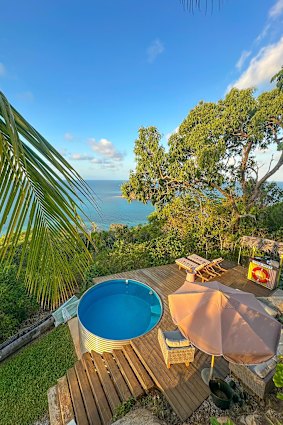
Owners considering a pool also need to budget for landscaping. Credit: Outback Plunge Pools
Swain said a basic in-ground fibreglass pool shell could be as cheap as $16,000.
“The cheapest concrete pool we install is $21,000, so that’s immediately a $5000 difference. And that concrete pool might cost $5000 more to deliver, making it $10,000 more expensive overall.”
Concrete does have its advantages: it’s exceedingly durable and can look more luxurious than other materials. But for the budget-conscious, fibreglass is a smart pick, according to Swain.
Home owners seeking a rustic look could choose a pool made from a recycled shipping container, such as those offered by specialist Aqua Pools.
The lined containers start at three metres long and cost from $33,000, with an additional $10,000 to $20,000 for installation.
Also finding favour with the budget conscious are modular kit pools, constructed from galvanised-steel panels (modules) and then lined with vinyl.
“The beauty of modular pools is their flexibility,” said Classic Pools director Ben Chapman.
“We can design endless shapes or customise the depth of the deep end.”
Like plunge pools, modular pools can be installed above-ground on a simple concrete slab. Classic Pools can supply a 6m x 3.6m modular pool for $7000.
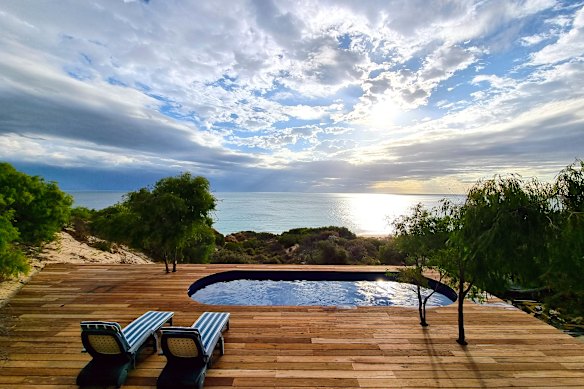
Modular pools can be installed in-ground or above-ground. Credit: Classic Pools
Modular pools can also sit in-ground.
“We excavate the hole, put the panels in, bolt them all together, then vacuum on the vinyl membrane,” said Chapman.
“And because it’s modular, we can make adjustments as we go. If the client changes their mind about the shape, we can change it then and there.”
Chapman said the result was virtually indistinguishable from a fibreglass pool.
“They really look the part. And they generally end up being about half the cost of a fibreglass or concrete pool.”
Chapman recommended budget-conscious householders stick to above-ground pool options.
“Unless you really know your site, the potential is there for negative surprises,” he said.
“If it’s a straightforward excavation, you might be looking at $2000 to $4000, but if you hit rock, the cost can go up quite dramatically.”
Another way to limit costs is to handle most of the labour yourself.
Rixon, from Outback Plunge Pools, said confident DIYers could install a plunge pool themselves.
But he said they might want to consider working with an installer, regardless.
“We’ve seen a big shift recently towards people buying our pools through resellers, and the feedback we’re getting is that people want to be confident they can get ‘boots on the ground’ if something needs fixing,” he said.
“That makes sense to me. It’s worth spending that little bit more upfront for peace of mind.”